

How Much Should Your Great Pyrenees Puppy Weigh?
TrendReactTees.STORE TeamGreat Pyrenees puppies grow quickly, but there's no single correct weight for every puppy. An online chart can give you a rough reference, while your puppy's individual growth pattern and your veterinarian's assessment give you a clearer picture.
This post may contain affiliate links. If you make a purchase through these links, I may earn a small commission at no extra cost to you.
If your fluffy roommate already runs the household, our Dog Eats Custom Kibble Living On Ramen Tee and My Therapist Is A Dog Tee bring dog-parent humor to your wardrobe.
Before you compare your puppy with every giant fluffball on the internet, start with the estimates below and what they can tell you.
Key Takeaways
- Your Great Pyrenees puppy's healthy weight depends on age, build, and individual growth.
- The age chart uses modeled estimates, not measurements from a large group of Great Pyrenees puppies.
- Adult males are generally heavier than females, but puppy weight estimates overlap.
- Growth can continue beyond the first birthday, without a universal finish date.
- If your puppy's growth seems unusually fast or slow, share the pattern with your veterinarian.
How much should my Great Pyrenees puppy weigh?
At 8 weeks, one growth model estimates a typical weight of about 14 to 15 pounds. By 6 months, its estimates are about 62 pounds for females and 69 pounds for males. Your puppy doesn't have to match those numbers.
For another perspective on Great Pyrenees size, you can watch this video:
Use these puppy weight estimates as a rough guide
BreedLookup's chart uses a giant-breed growth-curve model. These figures are estimates, not clinical targets or measurements collected from a large group of Great Pyrenees puppies.
Each cell shows a modeled typical weight followed by its usual range, all in pounds.
| Age | Male: typical (usual range) | Female: typical (usual range) |
|---|---|---|
| 8 weeks | 14.8 (10.6 to 19.7) | 14.1 (9.9 to 19.4) |
| 3 months | 28.0 (21.2 to 35.6) | 26.2 (19.4 to 34.1) |
| 4 months | 42.8 (33.7 to 53.1) | 39.4 (30.1 to 49.9) |
| 5 months | 56.7 (45.0 to 69.3) | 51.4 (39.8 to 64.8) |
| 6 months | 69.1 (55.4 to 84.3) | 61.6 (48.1 to 77.0) |
| 8 months | 87.3 (70.0 to 104.9) | 77.1 (60.9 to 94.7) |
| 10 months | 96.2 (78.2 to 114.8) | 84.5 (67.3 to 103.4) |
| 12 months | 99.7 (80.3 to 119.2) | 87.1 (69.1 to 107.5) |
| 18 months | 105.4 (86.0 to 126.8) | 92.5 (73.4 to 113.1) |
| 24 months | 108.4 (88.6 to 130.4) | 95.0 (76.7 to 117.0) |
The ranges are broad, and none guarantees where your puppy will land. Even the last row is a model estimate, not a promised adult weight.
How to read a modeled range
Find your puppy's age and sex, then use the range for context. A number near the middle doesn't automatically confirm healthy condition, and a number outside the range doesn't automatically mean something is wrong.
Keep your puppy's previous measurements handy when you talk with your veterinarian. A series of weigh-ins gives you more context than one comparison with an online table.
What adult weight can your Great Pyrenees grow into?
Your tiny cloud has a large-dog future, but adult estimates aren't identical across sources. Frame and individual build matter, so a breed figure shouldn't become a number you're trying to make your puppy hit.
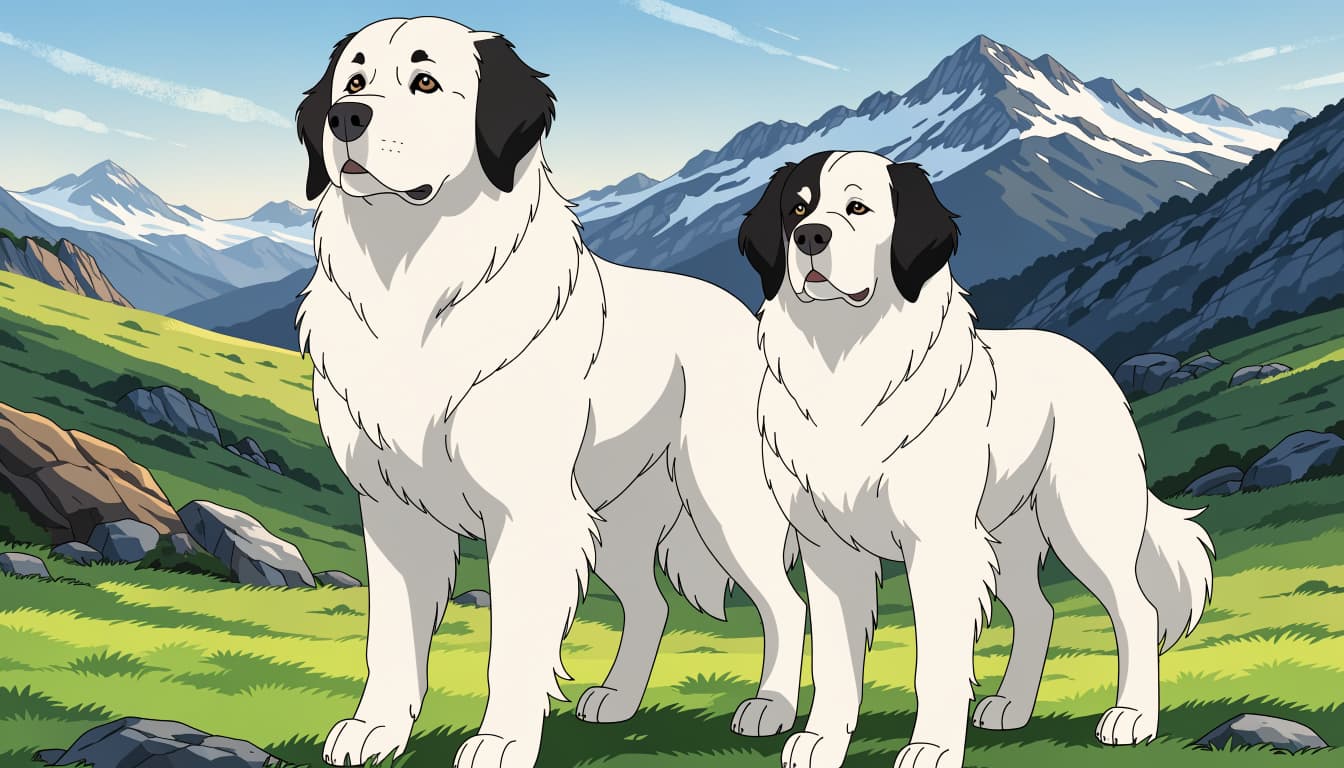
Why adult size estimates differ between males and females
PetMD describes adult female Great Pyrenees at 85 to 100 pounds and males at over 100 pounds. The Canadian Kennel Club gives a broader breed range of 90 to 125 pounds and notes that females are somewhat smaller.
Those descriptions support a general adult size difference. They don't establish an exact gap between male and female puppies at every age. Your puppy's sex is useful context, not a prediction with an expiration date and a guaranteed final number.
What adult ranges mean for your puppy
Some breed descriptions use minimum-style figures rather than complete ranges. For example, WebMD's breed profile describes males at 100 pounds and up and females at 85 pounds and up. Those numbers don't tell you the upper weight for every healthy adult.
The age chart uses a separate model, so its 24-month estimates won't necessarily match another source's adult description. Give your puppy room to have an individual build, and ask your veterinarian how that build fits with their growth.
How your puppy's growth changes with age
Early puppyhood can feel like watching a character level up between meals. In the model above, the typical male estimate rises from 14.8 pounds at 8 weeks to 56.7 pounds at 5 months. The female estimate rises from 14.1 to 51.4 pounds over the same ages.

A separate large-breed chart model estimates 85% of adult weight at 12 months and 100% at 18 months. Those percentages are approximate and come from a different model than the table. They don't promise that your dog will stop growing on a particular birthday.
Why a steady trend matters more than one weigh-in
Repeated measurements help you see how your puppy is growing over time. Genetics, sex, diet, and neuter status can all affect the pattern, so another puppy's trajectory isn't a personalized plan for yours.
A single weigh-in can still be useful context for your veterinarian. Paired with earlier measurements and an assessment of your dog, it becomes much more informative than a number viewed on its own.
What weight charts cannot tell you about body condition
A chart can't confirm whether your puppy is at a healthy body condition. Two dogs can weigh the same amount and have different frames, so the scale doesn't provide the entire picture.
Your veterinarian can assess your puppy's condition alongside their growth. The World Small Animal Veterinary Association's body condition chart provides general information about the scoring system, but it doesn't replace an individual assessment.
When should you ask your veterinarian about puppy weight?
If your puppy's growth seems unusually fast or slow compared with their own earlier measurements, discuss it with your veterinarian. You don't need to wait until a chart gives you a particular number before asking a question.
Your veterinarian can consider your puppy's age, build, growth history, and condition together. That matters more than trying to diagnose a dog through a browser tab and a very determined search history.
Keep a simple record of your puppy's growth
Record your puppy's age, the date, and their weight at routine checkups or other weigh-ins. Bring those entries to your appointment so your veterinarian can see the pattern rather than relying on your memory.
You don't need to weigh your puppy constantly or chase an exact chart value. A consistent record is there to support a conversation, not turn your home into a miniature data center.
Streetwear & Casual Styling
Once the puppy admin is handled, your dog-parent outfit can have some personality too. Our Scream At Void My Human Understands Tee pairs cyber-brutalist anime energy with dog-owner humor.
For another easy look, wear the If They Could Use Internet Tee with relaxed jeans and sneakers. Your puppy supplies the fluff. You supply the graphic tee.
Frequently Asked Questions
How much should an 8-week-old Great Pyrenees puppy weigh?
The model estimates a typical weight of about 14 to 15 pounds for either sex at 8 weeks. Its usual ranges are broad, and they aren't veterinary standards. Your puppy's individual growth and condition matter more than matching that estimate.
Do male Great Pyrenees puppies weigh more than females?
Adult males are generally heavier than adult females in the cited breed descriptions. Puppy estimates overlap, though, and the model doesn't prove a fixed difference at every age. Your individual puppy may grow differently from either typical estimate.
When do Great Pyrenees puppies stop growing?
A large-breed model shows growth continuing beyond the first birthday, with an approximate endpoint at 18 months. That model doesn't guarantee when your individual dog will finish growing. Your veterinarian can help interpret your puppy's progress as they mature.
Should you worry if your puppy is outside an online weight range?
An online modeled range isn't a diagnostic cutoff, so one number outside it doesn't establish a problem. If the pattern concerns you, share your puppy's measurements with your veterinarian. They can assess your puppy as an individual rather than relying on a chart alone.
Give Your Puppy Room to Grow
The age table gives you a starting point, not a verdict on your Great Pyrenees puppy. Your dog's own measurements and veterinary assessment offer a better guide than a perfect match with an online estimate.
Keep a simple record, bring your questions to your veterinarian, and let your puppy be an individual. That enormous personality already has the assignment covered.