

Print on Demand Shirts: How Made-to-Order Tees Actually Work
You've found a graphic tee online that looks perfect, selected your size, and reached the checkout page. Then a few questions appear: What fabric is this printed on? How long will it take? Will the design still look good after washing? With print on demand shirts, the artwork is only one part of the purchase. The blank garment, print process, production location, quality checks, and delivery route all shape what arrives at your door.
Table of Contents
- What Print on Demand Shirts Actually Are
- How a Made to Order Shirt Gets Made
- The Blank Tee Behind the Design
- Print Methods and What They Change
- Lead Times and Regional Fulfillment
- Misconceptions Buyers Should Drop
- A Simple Buyer Checklist Before You Order
- What to Expect From Your Next POD Shirt
What Print on Demand Shirts Actually Are
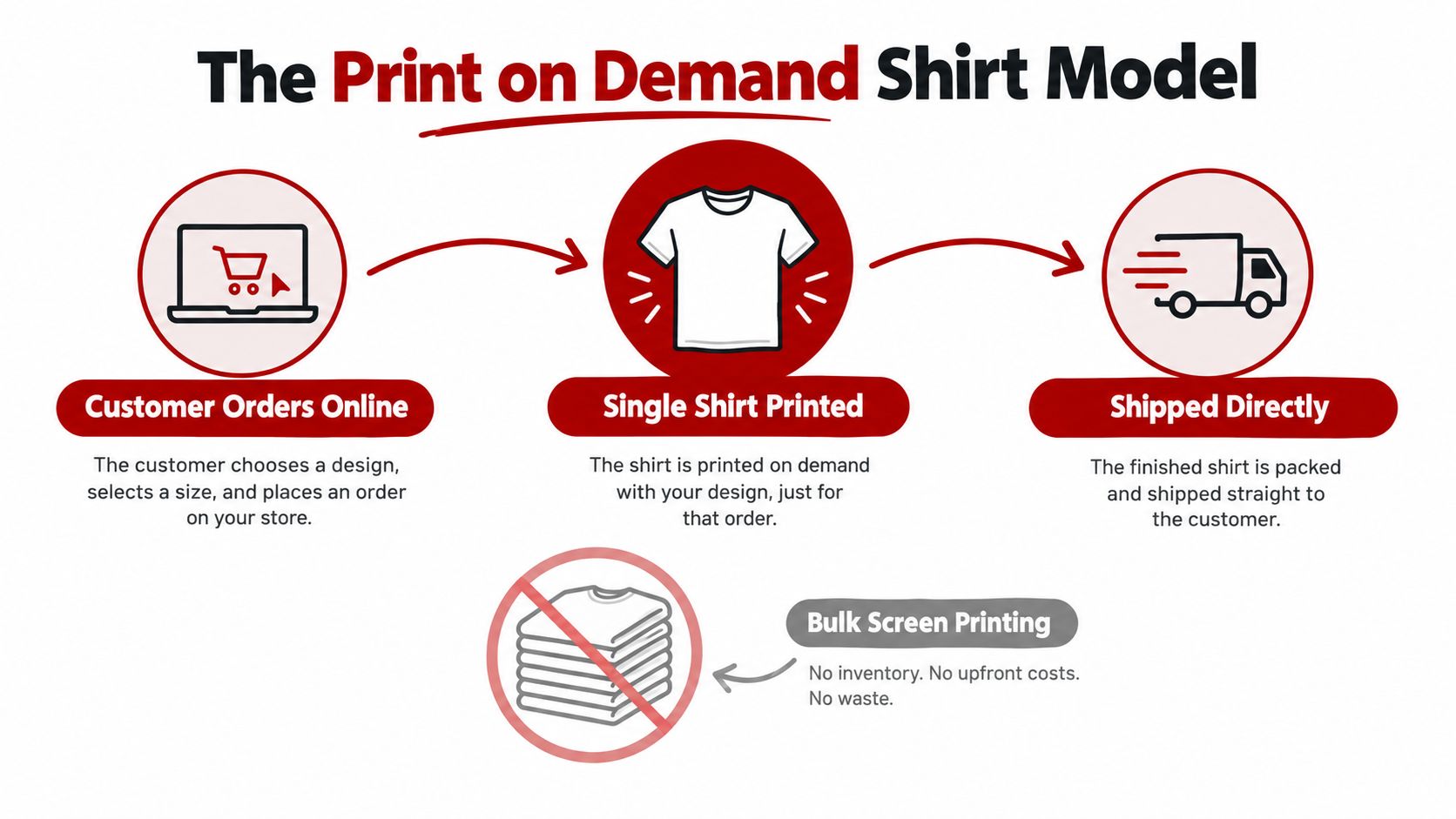
Print on demand, or POD, means a shirt is made after a customer places an order. An online store shows the design and garment choices, while a production partner supplies the blank shirt, applies the artwork, checks the result, packs the order, and sends it out. The finished tee does not usually wait in a warehouse for a buyer.
Bulk screen printing follows a different sequence. A brand orders many matching shirts first, stores them, and then sells from that stock. POD places the sale before production, so sellers can offer more designs, sizes, and colors without committing to the same volume in advance. That arrangement also reduces the chance of unsold inventory, although each individual shirt can cost more to produce.
The model developed partly as a response to apparel overproduction. Research summarizing industry findings estimates that fashion overproduction averages 35% globally, creating about 92 billion excess garments annually. In the UK, WRAP's 2024 estimate places fashion overproduction at 235,000 tonnes of textile waste each year, equivalent to 23 million garments weekly. Research on fashion overproduction and textile waste explains the wider waste problem that made made-to-order production attractive.
What you're paying for beyond the artwork
A POD shirt's price covers more than cotton and ink. It can include the blank tee, artwork preparation, pre-treatment, printing, curing, inspection, packaging, payment processing, fulfillment, and delivery. The blank garment affects fit and feel. The print method affects texture, color, and durability. The production region affects the delivery route and timing.
The practical tradeoff is clear. One-off production gives sellers design variety without requiring every option to be stocked, but it generally costs more than producing a large matching run. Industry coverage commonly places POD margins in the 20% to 40% range, as discussed in this overview of common on-demand shirt mistakes.
Practical rule: Treat a POD listing as a small manufacturing specification, not just a picture of a design.
Before ordering, identify the blank garment, print method, production location, and policy for fit or print problems. Those details explain what you are buying beyond the mockup.
How a Made to Order Shirt Gets Made
Take a simple example: you order a black graphic tee and enter an Ohio delivery address. The process begins much like a restaurant kitchen receiving a digital ticket. The store records the item, size, color, and address, then sends the order to its fulfillment system.
From checkout to production
First, the platform checks that the order is valid and identifies a suitable production partner. If the provider uses distributed manufacturing, software can route the order toward a facility serving the buyer's region. The goal is to avoid sending every shirt through one distant location, although the nearest facility may not always have the selected blank, color, or print capability.
Next comes the artwork file. Production staff or automated tools check the design's dimensions, transparency, placement, and color information. A file that looks sharp on a phone can still produce soft edges if it doesn't contain enough image detail. The team also confirms that the graphic fits the printable area and won't collide with seams, collars, or hems.
The printer then pulls the specified blank. For your Ohio order, that means matching the black color, unisex cut, size, and garment style selected on the product page. A substitute blank shouldn't be assumed unless the seller's policy allows it.
Printing, finishing, and hand-off
The print method depends on the fabric and artwork. A cotton tee may receive direct-to-garment ink, while a mixed-fiber garment may use a transfer process better suited to its surface. The garment can require pre-treatment before printing, followed by heat curing or pressing so the design bonds correctly.
After printing, the operator checks placement, color coverage, loose fibers, and visible defects. The shirt is folded, placed into a poly mailer or similar package, and assigned a shipping label containing the Ohio address. A carrier collects the parcel, and tracking begins once the shipment enters that carrier's system.
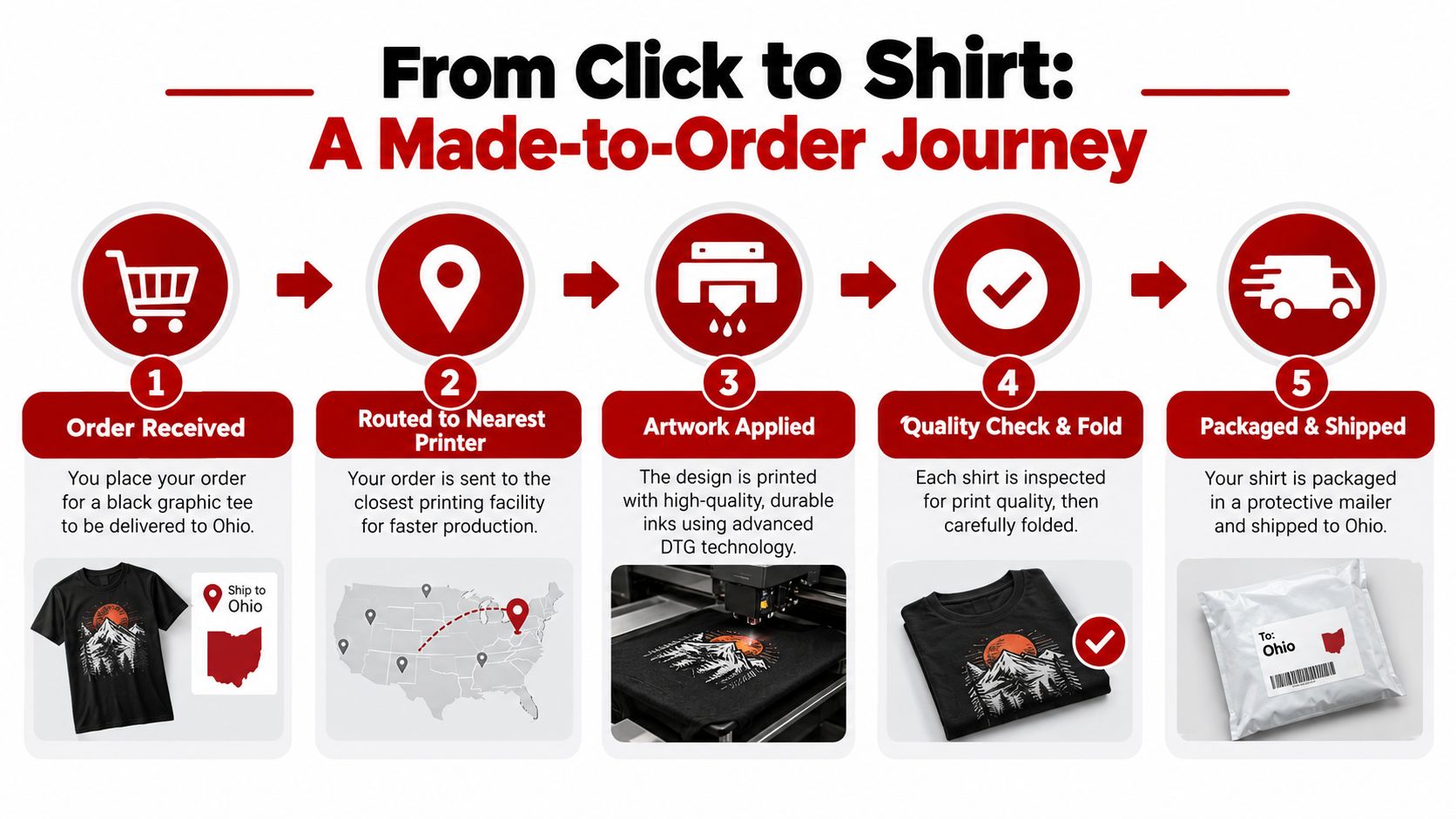
The important distinction is that production and transit are separate events. A tracking number may exist before the parcel has physically moved, and a carrier delay doesn't necessarily mean the printer missed the order.
This video offers a visual look at the shirt production and fulfillment workflow:
The Blank Tee Behind the Design
A graphic can be excellent and still feel disappointing if the blank tee is wrong for the buyer. Fabric weight affects how the garment hangs, yarn construction influences surface smoothness, and seams affect how consistently the shirt sits on the body.
The Bella+Canvas 3001 is a useful reference because its published specification identifies a 4.2 oz/yd², or 142 g/m², unisex jersey tee made from 100% Airlume combed and ring-spun cotton at 32 singles. It's available from XS through 5XL, according to the Bella+Canvas 3001 specification sheet.
The specification supplied for this style also highlights side-seamed construction and shoulder-to-shoulder taping. Side seams help the shirt maintain a more deliberate shape instead of twisting like a tube, while shoulder taping supports the neckline and shoulder area.
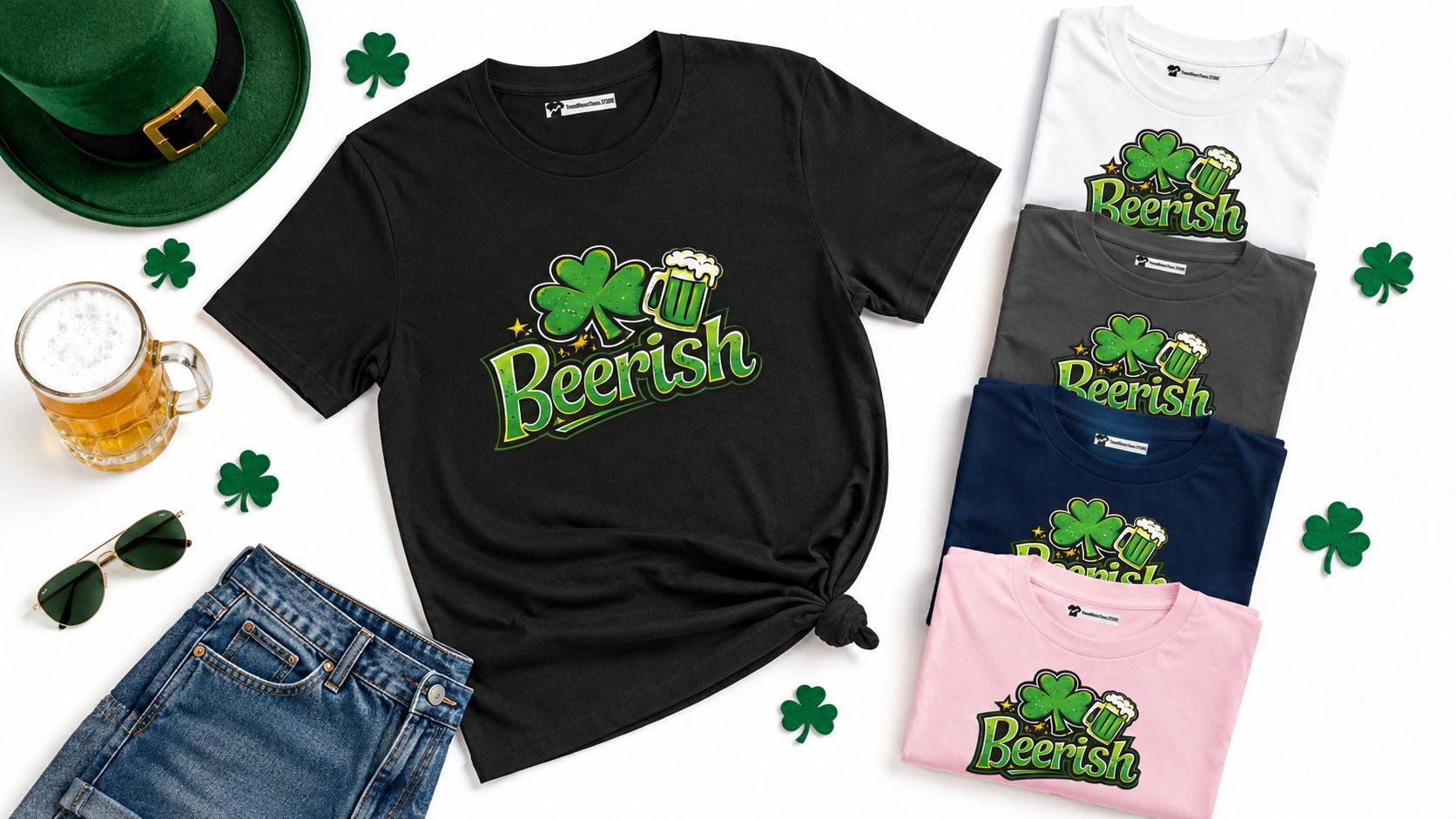
For a concrete example, Lucky St. Patrick's Day Parade Outfit " Beerish Vibes Only " Funny Retro Irish Shamrock Graphic Tee is described as a soft cotton tee for St Patrick's Day celebrations, with 67 variants across option1, option2, and option3.
Bella+Canvas 3001 Spec Snapshot
| Attribute | Specification | Why It Matters |
|---|---|---|
| Fabric weight | 4.2 oz/yd², 142 g/m² | Creates a lightweight feel and an easy drape |
| Fiber content | 100% cotton | Provides a natural fabric surface for cotton-compatible printing |
| Yarn construction | 32 singles, combed and ring-spun | Supports a smoother hand feel and fine surface |
| Fit range | XS to 5XL | Gives the seller a broad unisex size range |
| Construction | Side-seamed jersey | Helps the tee hold a consistent body shape |
| Reinforcement | Shoulder-to-shoulder taping | Supports the neckline and shoulder seams |
A lightweight tee won't feel like a heavyweight streetwear shirt, and that's not automatically a weakness. It may work well for layering and warm-weather wear, while a buyer seeking a structured oversized silhouette should look for a heavier blank instead. Fabric weight and fiber content matter more than a vague label such as “premium.”
For a broader comparison of natural and synthetic fabrics, see this guide to cotton versus polyester shirts. Retailers can also vary in sizing, colors, and fulfillment partners, so the blank's brand name should be checked against the exact product listing rather than assumed from a mockup.
Print Methods and What They Change
The print method determines how the design interacts with the shirt. It affects surface texture, breathability, color appearance, and how the graphic responds to washing. No process is universally superior.
Direct-to-garment, or DTG, sprays water-based ink onto the garment, making it suitable for detailed, full-color artwork on cotton and high-cotton fabrics. The ink becomes part of the fabric's surface rather than forming a separate plastic-like sheet. Pre-treatment and curing still matter, especially on dark garments, where the printer may need a foundation layer for strong color.
Direct-to-film, or DTF, prints the design onto a film and applies it with heat and adhesive powder. It can work across cotton, polyester, fleece, and blends, which gives sellers more blank choices. The tradeoff is a potentially more noticeable printed layer, particularly when the graphic covers a large area.
Sublimation bonds dye into polyester or another polymer-coated surface. It can produce vivid color and a smooth finish, but it isn't the natural choice for a standard 100% cotton tee. Screen printing remains useful for bold designs and larger runs because the ink is pushed through mesh screens, but setup and color requirements make it less convenient for isolated one-off orders.
| Method | Best For | Feel on Fabric | Wash Durability |
|---|---|---|---|
| DTG | Detailed, full-color graphics on cotton | Usually softer, with ink integrated into the surface | Depends on pre-treatment, curing, ink coverage, and care |
| DTF | Fine detail across cotton, polyester, and blends | Can feel more like a thin applied layer | Depends on adhesive, heat application, and washing |
| Sublimation | Vivid designs on polyester or polymer-coated garments | Smooth because dye becomes part of the surface | Generally strong when correctly applied to compatible fabric |
| Screen printing | Bold graphics and larger runs | Varies with ink deposit and print coverage | Often durable when properly cured and cared for |
Buyers should ask what method was used, whether the garment was pre-treated, and how the seller recommends washing it. Claims that any print will survive every wash should be treated cautiously. The same artwork can look crisp on a tightly woven blank and less defined on a rougher surface.
Finishing details also change the result. Check whether the design is centered, whether the collar remains clean, whether tags are removed neatly, and whether the neckline has adequate reinforcement. The practical differences between screen printing and transfer applications are outlined in this screen printing versus heat transfer comparison.
Lead Times and Regional Fulfillment
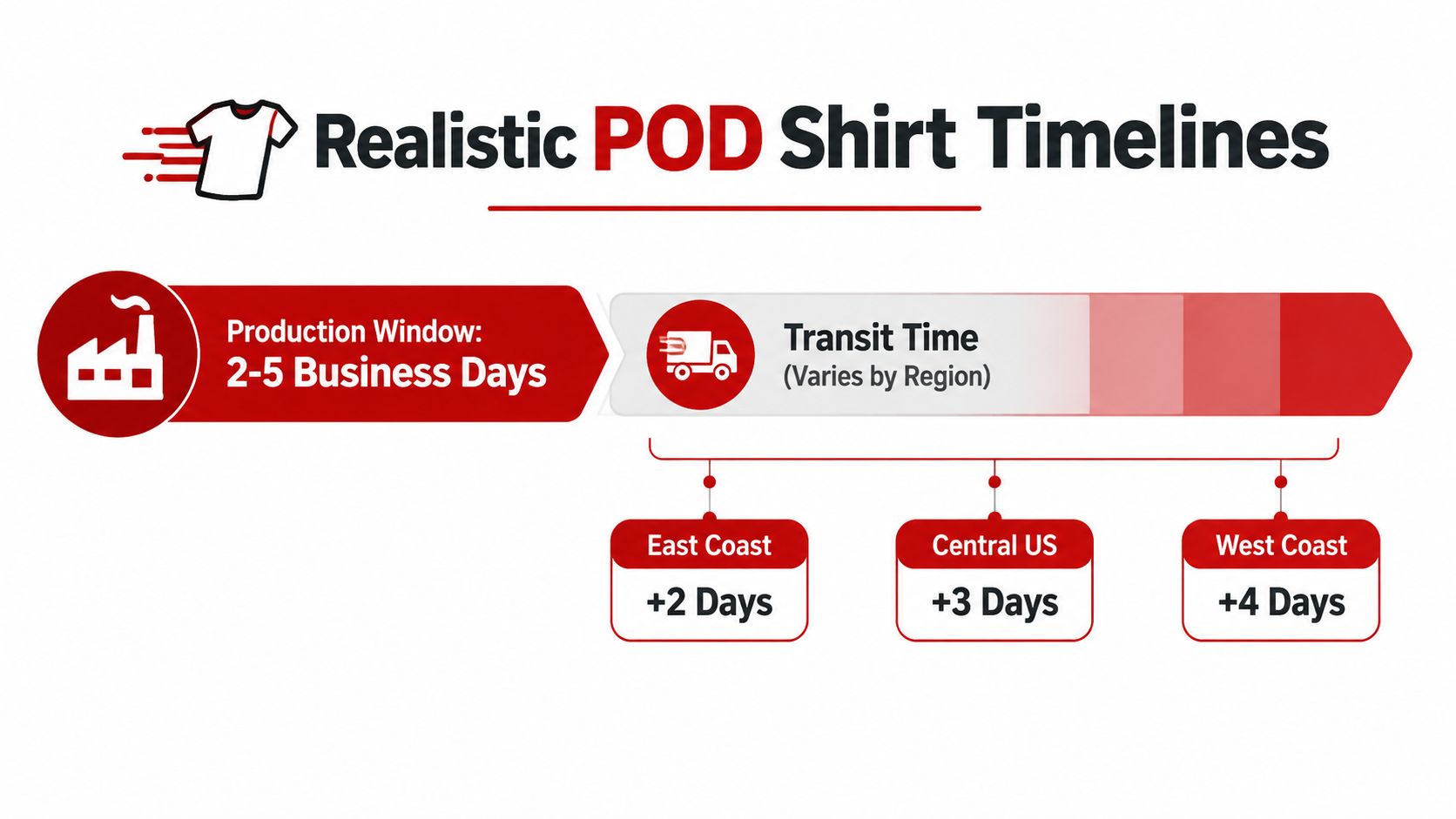
A POD delivery estimate runs on two clocks: production time and transit time. Production covers preparing the artwork, printing, curing, inspecting, and packing the shirt. Transit starts when the carrier accepts the parcel. A common production window is 2 to 5 business days. Shipping time then depends on the facility's distance, service level, destination, and border crossings.
Why location changes the calculation
A distributed network may include facilities serving the United States, Europe, Mexico, and Australia. Assigning an order to a regional printer can shorten the distance to the buyer, but it does not guarantee the fastest route. The system may also weigh garment availability, artwork requirements, inventory, and production capacity.
A Friday order might wait until the next working day if it misses the daily cutoff. Weekends and public holidays may fall outside business-day estimates. “Ships in five days” therefore describes a production or dispatch milestone, not arrival five calendar days after purchase.
For international orders, check how duties and taxes are collected. A parcel can leave the printer on schedule and still pause during customs processing, or create extra charges when those costs were not collected at checkout. Review the retailer's shipping policy before ordering for an event or gift date.
Regional fulfillment changes the transit leg, while the blank garment, print method, inspection process, and facility workload affect the production leg. Together, these variables explain what you are paying for beyond the artwork.
Delivery check: Add the production window to the carrier window. Do not count the order date as a shipping day unless the seller explicitly says production begins immediately.
Misconceptions Buyers Should Drop
POD shirts aren't automatically cheap, and they aren't automatically premium. The quality depends on the blank, artwork file, print process, operator, curing, inspection, and fulfillment partner. A polished mockup can't reveal every one of those variables.
The idea that POD quality is always random also misses how production systems work. Providers can standardize garment styles, artwork templates, printer settings, and inspection steps. At the same time, distributed production introduces the possibility of small differences between facilities, especially in color handling or placement.
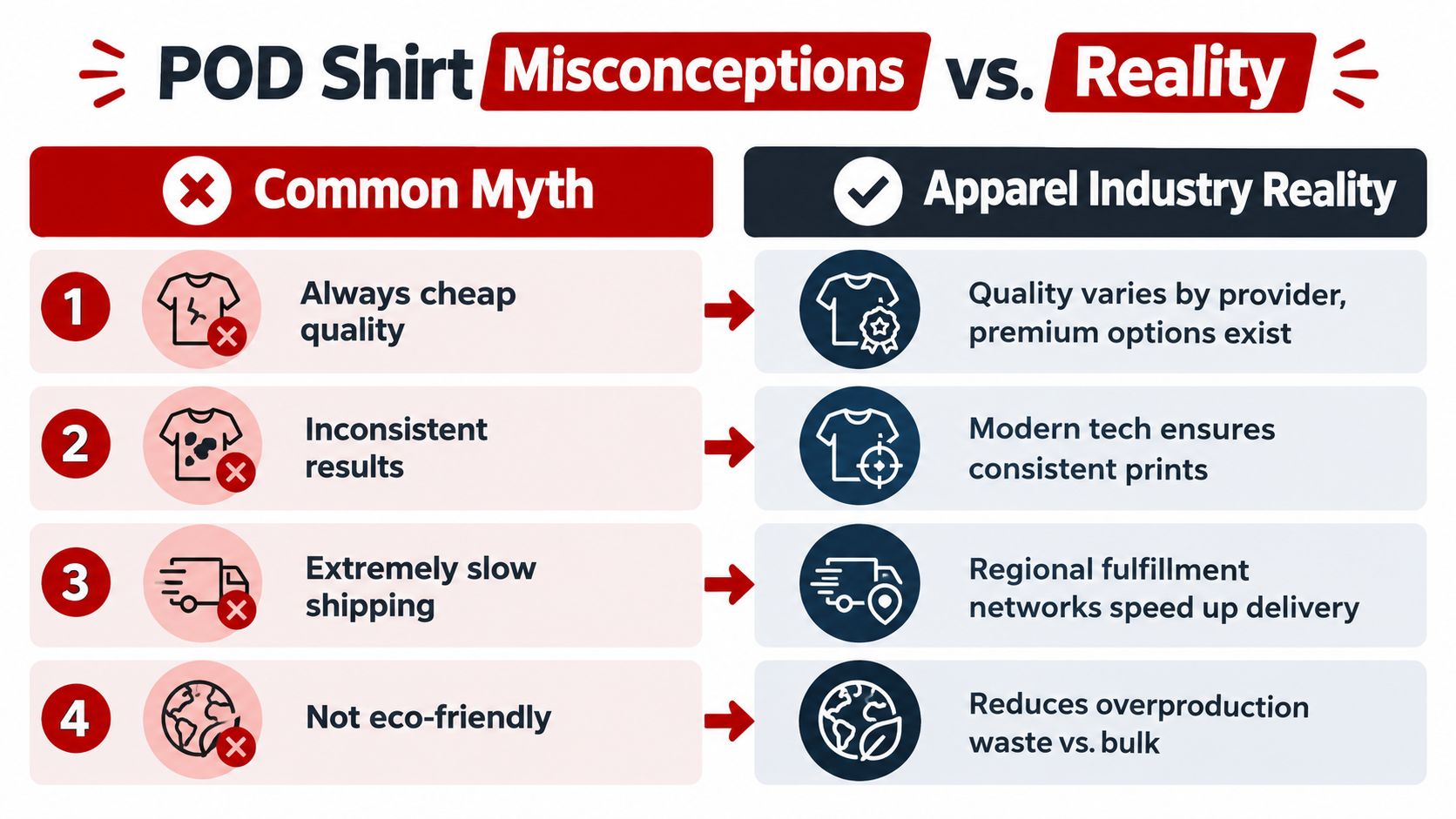
Four assumptions worth testing
- “Every POD shirt is low quality.” Some providers use recognizable retail-style blanks, while others prioritize lower production costs. Ask for the garment brand, style, fiber content, and fabric weight.
- “POD shipping is always slow.” Made-to-order production adds a manufacturing stage, but regional fulfillment can shorten the transit portion when the selected product is available nearby.
- “Made to order means impact-free.” Producing after purchase avoids much of the deadstock problem, and an academic review concludes that POD can minimize waste as a sustainability strategy in fashion operations. Review the academic discussion of POD fashion models. It doesn't eliminate fabric offcuts, packaging, energy use, chemicals, or transport.
- “Returns work like ordinary retail.” A printed shirt made for one customer may be difficult to resell. That can lead sellers to use replacement, refund, or keep-the-item policies instead of restocking every return.
The most useful mental model is not “POD equals good” or “POD equals bad.” It's POD equals a different set of tradeoffs. You exchange warehouse inventory and deadstock risk for per-order production, limited pre-purchase fitting, and dependence on a fulfillment workflow you can't see directly.
A Simple Buyer Checklist Before You Order
Use this checklist before buying any print on demand shirt. A transparent listing should answer most of these questions without forcing you to contact support.
- Identify the blank: Look for the garment brand and style number, not only a phrase such as “soft premium tee.”
- Read the fabric details: Check fiber content and fabric weight so you know whether the shirt is lightweight, structured, stretchy, or synthetic.
- Compare the size chart: Measure a shirt you already own and compare its width and length with the listing's measurements.
- Inspect the print information: Find out whether the design uses DTG, DTF, sublimation, screen printing, or another process, especially if fabric compatibility affects the result.
- Check fulfillment location: Look for the production region or facility information, because location affects transit and cross-border handling.
- Review the issue policy: Confirm whether defects lead to a refund, replacement, reprint, or return, and check who pays any return shipping.
- Look for real product evidence: Customer photos, sample images, and comments about print appearance after washing are more useful than a clean digital mockup.
- Clarify international charges: Confirm whether duties and taxes are paid at checkout or collected when the parcel arrives.
- Ask before purchasing: A seller should be able to explain fit, fabric, printing, production timing, and delivery expectations in plain language.
The size chart deserves special attention because unisex labels don't guarantee identical proportions across brands. A buyer who normally wears a medium may prefer a different size in a relaxed cut, but that decision should come from measurements rather than the label alone.
A sample order is the strongest quality check for sellers, but buyers can still evaluate transparency through the product page. Missing blank information, unclear production timing, and vague return language aren't proof of a bad shirt, but they're reasons to pause.
What to Expect From Your Next POD Shirt
A well-run made-to-order shirt should arrive looking like the product listing, with a consistent blank, an appropriately placed graphic, clean packaging, and tracking that reflects the parcel's actual movement. It shouldn't feel like a mystery box, even though the buyer doesn't watch the production line.
For many orders, allow a production period of 2 to 5 business days before transit begins. Total delivery can range from a short domestic journey to several weeks for a cross-border order, depending on the printer's location, carrier service, customs, weekends, and product availability.
Washing also affects the experience. Follow the seller's care instructions, and washing inside out in cold water is a sensible way to reduce abrasion and heat exposure. Small differences in color or placement can occur between production batches, but large misalignments, peeling, major cracking, or an incorrect garment are quality issues rather than normal variation.
POD's central advantage is choice without the same level of finished-goods inventory. The tradeoff is that you can't try the shirt on before ordering, and the garment is made for your purchase rather than selected from a shelf. That's why blank specifications, measurements, print details, and issue policies matter so much.
Regional networks may make domestic delivery more efficient over time, while broader blank catalogs can give buyers more choices in weight, fit, and fiber. The operational sequence will remain familiar: order, route, print, inspect, pack, and ship.
TrendReactTees.STORE offers made-to-order graphic T-shirts in Cyber-Brutalist and anime-aesthetic styles, with unisex Bella+Canvas 3001 blanks and fulfillment routed toward customer regions. Visit TrendReactTees.STORE to browse holiday and lifestyle designs, review the available garment details, and choose a shirt with the production model explained clearly.